
Davis County Warrant Searches
The Utah Bureau of Criminal Identification links the free Utah Statewide Warrants search. Court activity moves into the statewide file through court systems; each court is responsible for entering or removing its own warrant. BCI is the broad first check, while the court listed on a match controls the case and can explain the next step.
Use your exact name and compare a possible match with your own court papers. Keep case and warrant numbers, but do not copy someone else's result into a post or message. The accessible public interface did not reveal every form field, so use the public page as a name search and ask the clerk to confirm.
- Start at BCI's warrant page and follow its statewide-search link.
- Write down the court, case number, and warrant number shown for your own possible match.
- Call the court that issued the case. City citations may be in a city justice court or a Second District location.
- If the court is unknown, call BCI at (801) 965-4437; Davis Court says the BCI line can route callers to a court and case number.
- Request public records from the right office if an online record does not answer the question. Confirm with the clerk after any action.
The Public BCI Search Is Name-Based
BCI's public page calls the service a free statewide warrant search. The live front end returned an access error during research, so the public field labels and result layout were not captured. Do not promise a date-of-birth field, photo, bail amount, or physical description. The public route is described as a name search, with court confirmation after a possible match.
The BCI landing page is the documented starting point. Keep the query personal and use a result to find the court, not as a final ruling about current service status.
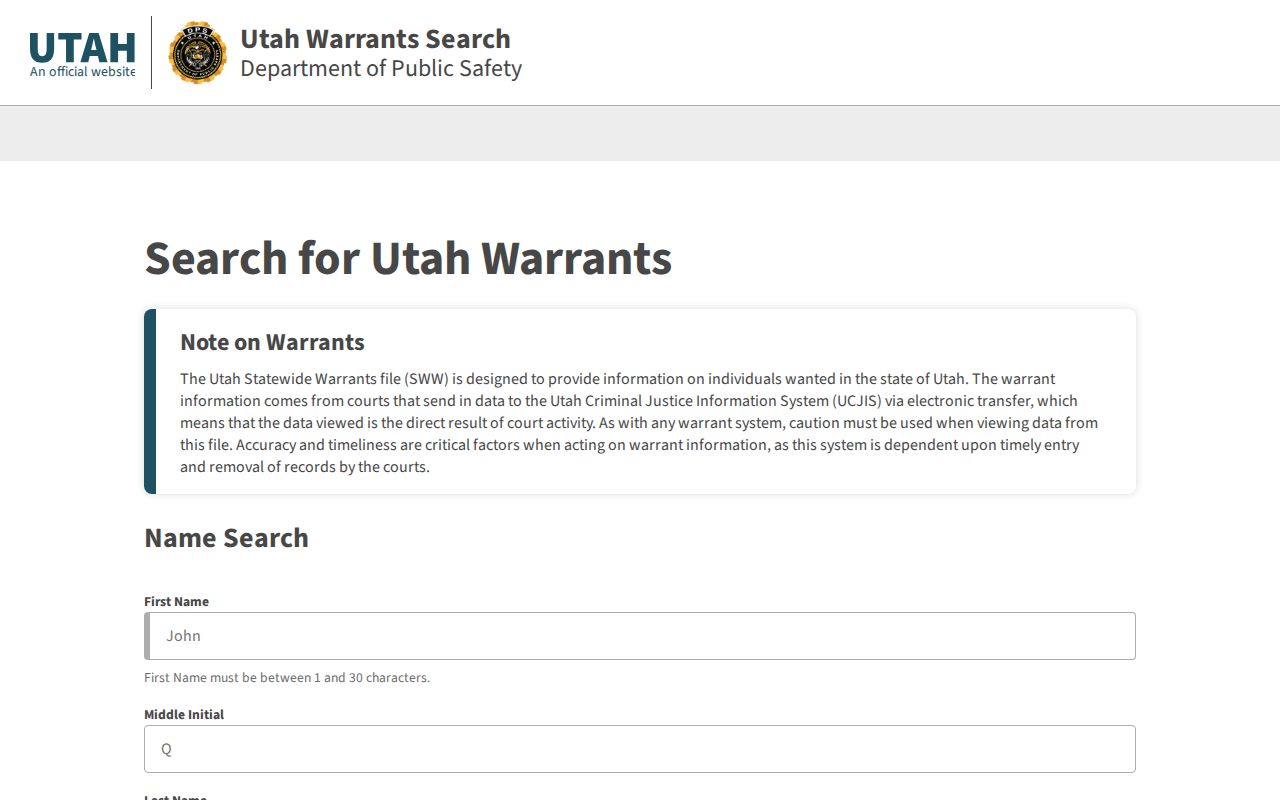
The image frames the public search entry page, without any individual result. Open the official statewide search from BCI.
Warrant Search Fields Explained
Several interfaces serve different jobs. The public BCI site exposes a name-search service, but the research could not confirm its exact controls. The UCJIS manual describes broader authorized QSW fields; those are law-enforcement options, not public instructions. Davis County's CORIS payment screen is a citation/case account search, not a public warrant database.
| Field Label | Type | Required | Notes |
|---|---|---|---|
| Public BCI search | Name text | Not captured | BCI describes a free statewide name search; public form details were not visible. |
| QSW by name | Authorized query | Per query | UCJIS manual; agency use only. |
| QSW case / warrant number | Authorized query | Per query | Not confirmed as public web fields. |
| CORIS court | Dropdown | Unspecified | Choose the court location that handled the citation. |
| Citation or case number | Text | Practical identifier | Case numbers are unique to a court location. |
Authorized QSW Fields Are Different
The UCJIS manual lists inquiry paths by name, Social Security number, operator-license number, vehicle-license number, case number, warrant number, and index. This is a protected agency transaction. A public reader should not enter sensitive identifiers into an unverified screen or assume the statewide public site supports the same options.
For a local payment account, use only the fields the official portal requests: court selection and citation or court case number. A missing account can mean the citation has not been filed yet, the court choice is wrong, or no money is owed. Ask the clerk rather than guessing through different identifiers.
Davis County Warrant Search Results
No private result or public sample listing was captured. The statewide manual supports broad categories of outstanding Utah felony, misdemeanor, and infraction warrants. A match may help identify the source court and warrant type, but the public screen's complete schema is not known. Do not assume it shows bail, birth date, judge, photo, or service date.
| Case / warrant number | Record identifier; the Davis public format was not established. |
|---|---|
| Court | Use it to reach the clerk with authority over the case. |
| Warrant class | Statewide scope includes felony, misdemeanor, or infraction warrants. |
| Reason | May relate to a charge, citation, or failure to appear; confirm with court. |
| Status | Entry and removal depend on court updates; an online status can lag. |
| Example | Use the case number shown by the court |
XChange Adds Court Case Context
Utah Courts XChange offers public case information with guest and account controls. Public access is limited to public cases; some records are restricted. MyCase serves people who are parties in eligible cases, while paid XChange access is a separate option. Neither should be treated as a dedicated, exhaustive warrant-clearance service.
Use court case information to identify the correct clerk and case, then ask whether the warrant is still active. A case entry can remain visible after a warrant is recalled, and restricted matters may be absent. The clerk's current answer is more useful than guessing from a search page.
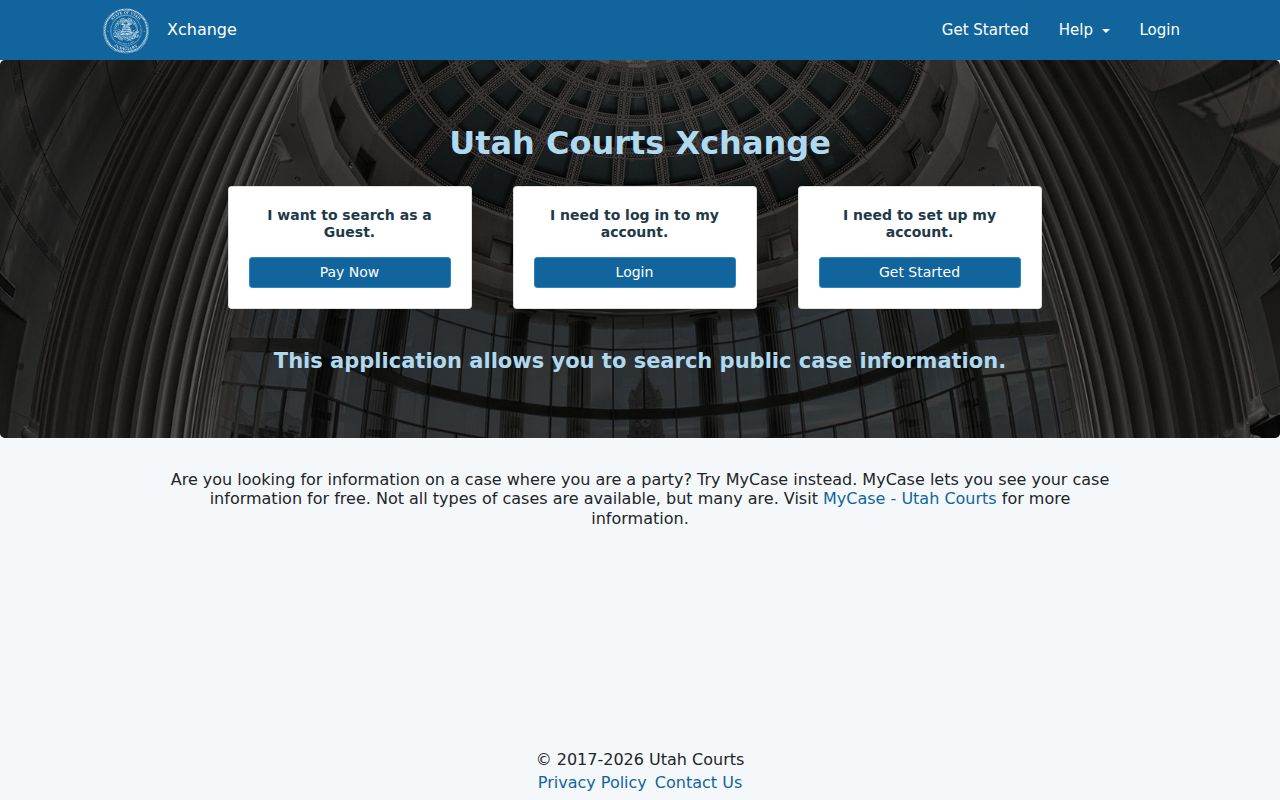
The guest-access screen shows the separate court-case tool and its access choices.
Davis County Warrants: Who Holds What
The issuing court holds the court case and controls recall. The Sheriff says public requests may be made for current warrants or criminal proceedings, but its website does not offer an active-warrant roster. Municipal police records are about police files; city court clerks handle city cases. BCI is the statewide cross-check, not the desk that can recall a local order.
For Davis County Justice Court, call (801) 451-4488 on weekdays from 9 a.m. to 3 p.m. BCI at (801) 965-4437 is available around the clock for routing help. Clearfield, Syracuse, Layton, and Bountiful have separate court contacts; Kaysville ordinance cases route to the Davis County court.
Davis County Court Calls Beat Guesswork
A city citation should be checked with the court printed on it. Clearfield Justice Court is at 55 South State Street and answers at (801) 525-2760. Syracuse Justice Court lists 1979 West 1900 South and (801) 825-1477, but call to confirm the address before travel. Second District Court contacts in Bountiful and Layton are (801) 397-7000 and (801) 444-4300.
Bring the citation or case number, ask if the warrant remains active, and write down the required action. A records request is a fallback for a record copy, not a substitute for asking the court what will recall an order.
The Utah Courts hierarchy explains why a city justice court and a district court have different case roles.
Which Warrants Stay Restricted
GRAMA makes many records public but does not open every case. Utah law allows a court to restrict an arrest warrant before service for good cause. Juvenile files, sealed records, and protected law-enforcement information may not appear in a public search. The clerk can explain whether a record is public and how to request it.
Key Rules:
An arrest warrant may be restricted for good cause before service under Utah Code §63G-2-305.
Juvenile records have special limits; route a juvenile matter to Juvenile Court in Farmington.
A missing name can reflect a restriction, data lag, or different court. Ask the issuing clerk.
GRAMA Is the Records Fallback
When an online check leaves a question, direct a narrow request to the office that holds the record. Davis County NextRequest handles county-held records. The Justice Court has its own one-page GRAMA form, requires identification, and releases only public records. The Sheriff also accepts requests for records it keeps. State your own case or citation number and ask for current status if releasable.
Do not expect a request to expose a sealed, juvenile, unserved restricted, or law-enforcement-only entry. The county gives a response period of up to ten working days for a record or denial. Copy and delivery charges may apply.
Davis County public-records and NextRequest information